
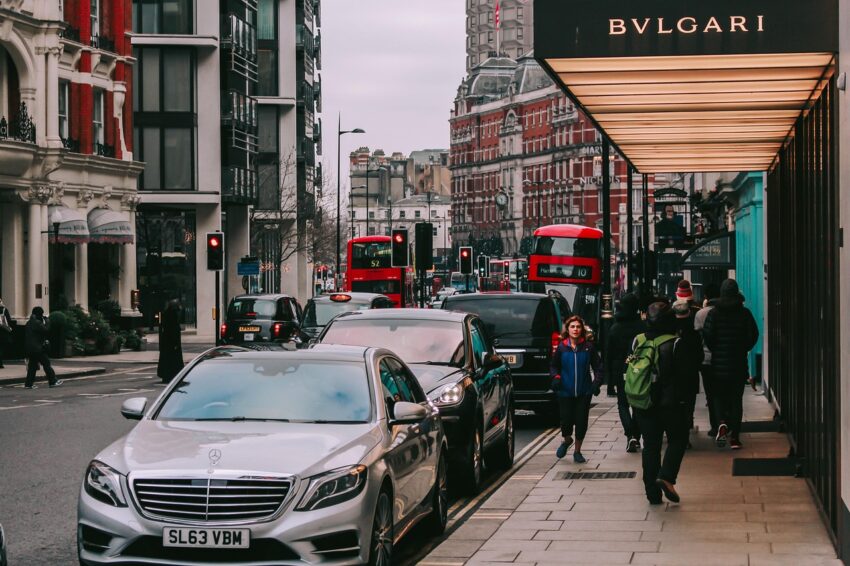
The United Kingdom has a long and proud history. But, there is one thing, about all else, that most travelers notice in Britain. The cars are whizzing by on the “wrong” side of the road. But is it really wrong? Or just British?
Buckle up as we steer through a few centuries of tradition, rebellion, and roundabouts to uncover why all of the United Kingdom (and a few other countries) still drives on the left.
Table of Contents
Medieval Mornings and Sword-Side Logic

Back in the Middle Ages, long before traffic signs or SUVs, travel happened on foot or horseback. And since most people were right-handed, they instinctively passed each other on the left to keep their sword arm between themselves and potential threats.
In a time when duels weren’t just for honor but sometimes for survival, it was wise to walk—or ride—with your dominant hand free. Even the Vatican got involved. In 1300, Pope Boniface VIII directed pilgrims to stay to the left while journeying to Rome.
Religion, it turns out, has been influencing traffic for quite some time.
Knights, Jousts, and the Left-Hand Code
The United Kingdom is synonymous with knights in shining armor and Arthurian tales. But those shimmering defenders of the realm also influenced our right-left conundrum. Keeping left wasn’t just convenient—it was the standard. During jousts and battles, charging from the left allowed right-handed fighters to align their lances correctly. It was essentially a military formation on horseback.
Left-side travel gradually became an unwritten rule across much of medieval Europe. It was safer, smarter, and socially expected. If you veered right, it signaled you were up to no good—or at least uncomfortably continental.
Enter Napoleon: The Man Who Flipped the Continent
The biggest shakeup came with Napoleon Bonaparte. Not only did he conquer much of Europe in the Nineteenth century, but he also brought along new traffic rules. Napoleon enforced right-side driving in the territories he controlled, helping it spread across France, Germany, Italy, and Spain.
Why? Some believe it was to break from aristocratic customs and distance France from British influence. Others say it had more to do with wagon technology: drivers sat on the left rear horse to whip with their right hand, which made it safer to pass oncoming wagons on the right side of the road.
Whatever the reason, Napoleon’s reforms flipped Europe. Britain, meanwhile, remained unmoved—and unflipped.
The British Refuse to Budge

While Europe made the switch to the right, the United Kingdom stood its ground. In a nation where tradition often outweighed logic, keeping left felt natural, even noble.
Ultimately, the historical practice was legislated. The General Highways Act of 1773 and the more influential Highway Act of 1835 codified left-hand travel. It wasn’t just custom; it was law.
Britain’s growing empire exported left-hand traffic wherever it planted a flag. India, Australia, New Zealand, and various African colonies all followed suit. For many, the direction of travel became a lasting legacy of British rule.
The Industrial Revolution and the Birth of the Motorcar
When automobiles arrived in the 19th century, they had to adapt to existing road customs. In Britain, this meant cars were driven on the left with steering wheels placed on the right side of the vehicle, giving drivers better visibility of oncoming traffic and tight corners.
Meanwhile, in the U.S., Henry Ford’s Model T was designed for right-side driving. The Model T’s popularity helped cement right-hand traffic in North America and later influenced countries globally through U.S. car exports.
But not in Britain. The British auto industry followed its own path—one that curved left.
Why Didn’t the United Kingdom Switch Like Everyone Else?

Many European countries eventually adopted right-hand driving to match their neighbors and simplify cross-border travel. Sweden made its famous switch in 1967, a well-coordinated event known as Dagen H (“H Day”), which required radio broadcasts, military logistics, and millions in infrastructure changes.
The United Kingdom saw the logistical nightmare and politely declined.
Switching sides in a developed nation is no easy feat. Every road sign, intersection, car design, and driving school would need an overhaul. And frankly, there wasn’t much incentive. The island already functioned perfectly well on the left—and, as far as the Brits were concerned, the rest of the world was going the wrong way.
The British Empire Drives On
Today, approximately 75 countries still drive on the left side of the road. Most are former British colonies, including:
- India
- Pakistan
- Australia
- South Africa
- New Zealand
- Singapore
- Caribbean
- Japan – for historical reasons tied to samurai culture and British-built railways in the 19th century.
Even in reassigned countries like Hong Kong, traffic remains left-handed. Colonial infrastructure is difficult to replace, especially when doing so would cause urban chaos.
In short, the British way stuck. And in many places, it still sticks.
Left, Right, or Just British?
Left-hand driving is more than a practical matter—it’s a quirk of national identity. In the U.K., it’s just how things are done. It’s the polite side, the historical side, the slightly eccentric side.
British drivers don’t mind the double-takes from tourists or the mild panic of Americans navigating roundabouts. It’s all part of the charm. Where else can one apologize profusely while accidentally driving into oncoming traffic?
Fun Facts About the United Kingdom That Might Surprise You
- The London Underground has its own “keep left” policy for foot traffic—unless you’re on an escalator, where you stand on the right. Because, why not?
- The Isle of Man, famous for its motorcycle TT races, drives on the left and has no speed limits on rural roads. Hold onto your tea.
- In the United Kingdom, postal vehicles, garbage trucks, and even ambulances are specifically engineered for left-hand driving. Swapping sides would be a logistical Everest.
A Legacy of Left-Hand Logic
So, why does the United Kingdom drive on the left? The reasons are rooted in centuries of social norms, military tactics, and colonial expansion. It wasn’t just tradition—it was safety, strategy, and sheer historical momentum. Switching never made much sense, and perhaps that’s the most British thing of all: if it’s not broken, why fix it?
[ This article may contain links that provide the website with a small commission. ]

Rhonda Fletcher
Rhonda is an articulate hodophile, wine lover, and dedicated travel journalist and photographer. She focuses on culinary and cultural exploration, wildlife expeditions, ancient discoveries, and ecologically sustainable travel. Follow her exploits and shenanigans on X and Instagram: @rr_fletcher